Coins We Love: The Suspected S-Mint Variety

I recently attended the American Numismatic Association National Money Show in Savannah, Georgia, and left with a fascinating story and a seemingly undiagnosed variety! I was handed a 1877-S $2.5 in PCGS MS62 for consignment. A lovely coin that we are thrilled to offer with no reserve in our Sunday, March 22nd, auction.
In my research of the coin, I viewed past examples we have handled, as well as recent auction results, and noticed a huge difference between some of the coins. Some coins, including the piece we picked up at the show, bear the mintmark above the 1, between the Eagle’s talons and the arrow’s nock, but on others above the space between 2 and D, between the arrow fletchings and the stem.
This is a pretty noticeable difference, so I dug deeper to see if this is a recognized Type 1 and Type 2 variety, or if it was an undiscovered, rare error. To my surprise, it’s neither! I researched all avenues and found next to NO mention of such differences, but I found several examples of each “variety” in past auctions. So it is not a never-before-seen rarity, but it’s also not a known, popular variety. Fascinating!
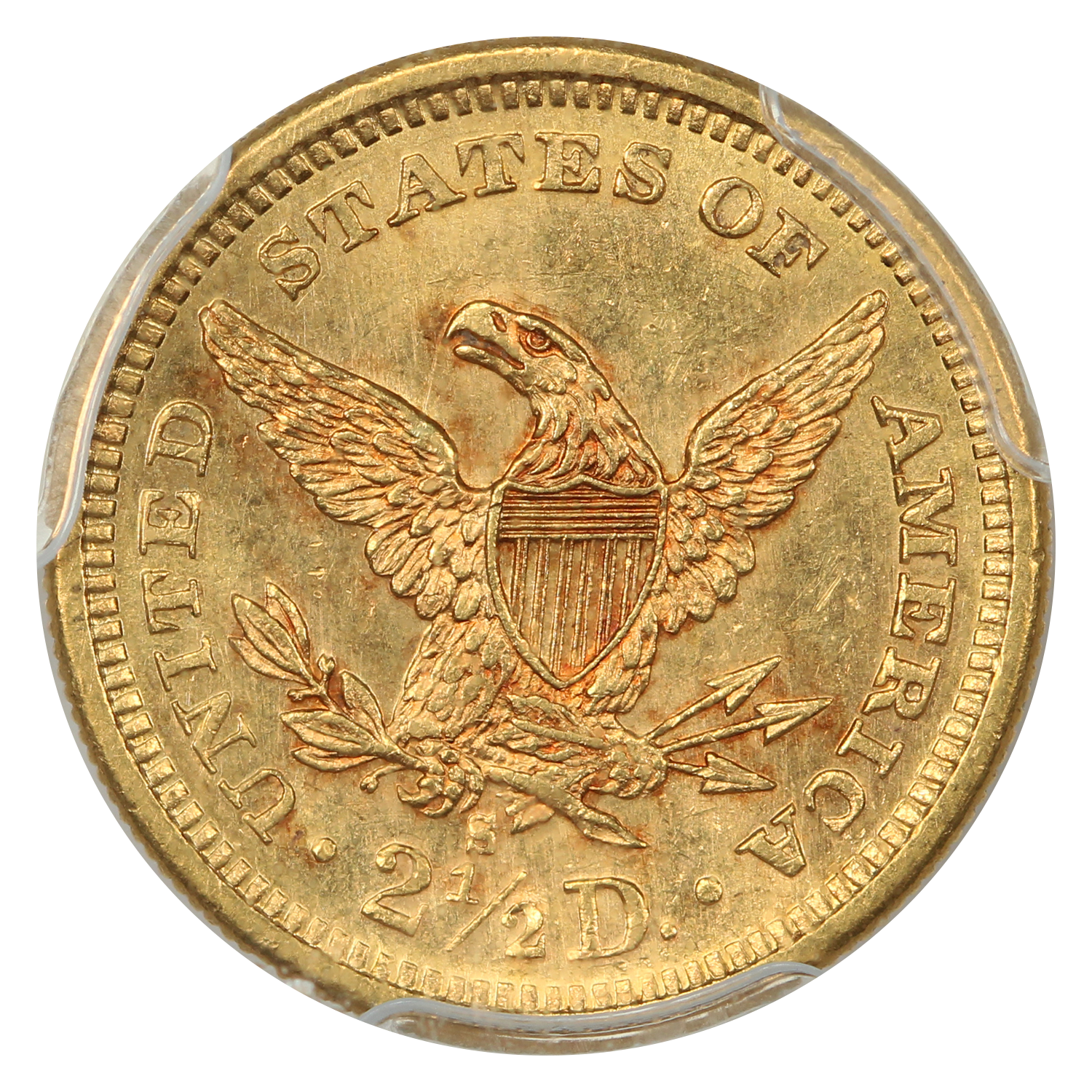
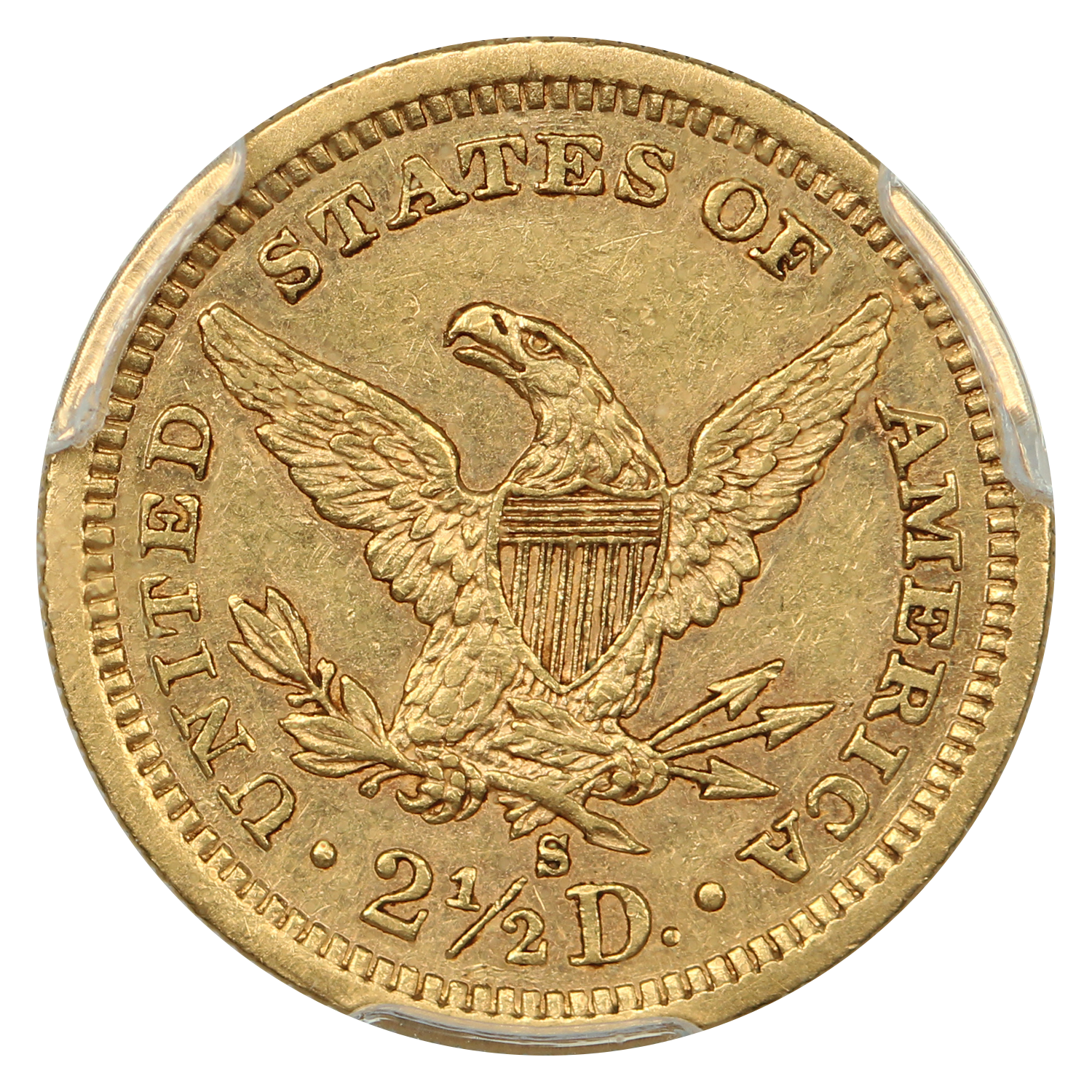
I reached out to Ron Guth, a well-known and extremely knowledgeable numismatist and researcher, to see if he was able to shed some light on the topic. Guth responded, “Mintmark placement is often random (see Barber Quarters and other series). I don't think it's an old versus new reverse kinda thingy; rather, it's just a different mintmark placement. However, it would be interesting to check to see if the same reverse shows up in previous or subsequent years.” I suspected that it could be a mintmark variance, but the placement seemed too wildly different to be summed up as such.
Guth recommended that I reach out to Doug Winter, and he similarly stated, “I’ve not studied the reverses of the 77s quarter eagles but would not be surprised to learn that there are at least two mm positions and maybe even a third.”
So, as suggested, I looked into 1876-S and 1878-S Quarter Eagles to see how the 1877-S compared mintmark-wise. I noticed that 1877-S is the first year San Francisco Quarter Eagle to feature a “new reverse”, which boasts a smaller eagle and a smaller mintmark, roughly half the size of previous years. The old reverse of 1876-S boasts a large mintmark that is always, as far as my research proved, between the Eagle’s talons and the nock of the arrow, above the 1. So, we struck out there, but I found something interesting when looking into the 1878 S-Mint issue. Not only does 1878-S show both mintmark positions from 1877-S, but also shows another position, squished right below the lower tip of the arrow fletchings, above the / (in ½).
Upon thinking this through, I dug deeper into the dies. It would make sense that the 1877-S was struck with fewer dies than the 1878-S, as the mintage pales in comparison, 35,400 vs. 178,000. However, according to Walter Breen’s “Complete Encyclopedia of U.S. and Colonial Coins”, both the 1877-S and 1878-S were struck from four pairs of dies. This book also states “4 Pairs of dies, minor positional vars. May exist with “Type I” rev. As formerly.” for the 1877-S and “4 pairs of dies, of which 3 have this style S (as in 1877); they vary notably in positions of S and date.” for the 1878-S.
So, problem solved!? Turns out, they are just mintmark position variances. But I do still have some questions.
- Why does Breen list “minor positional vars.” for 1877-S and “vary notably in positions of S” for 1878-S, even though the positions are the same, save for an extra 1878-S placement?
- Is this placement discrepancy large enough to warrant formal varieties?
- If this were a Morgan Dollar, you bet your bottom “dollar” that this would be a variety with sub-varieties, so why is that not the case for this $2.5 issue?
Some questions may never be answered. While I raced down this rabbit-trail, I did find a few nuggets of information:
- According to my research, the “Type 1” variety (between the talons and arrow, above 1) is the more common of the two identified placements. There are 27 auction records on PCGS CoinFacts from 2020 to present, 16 are Type 1 and 11 are Type 2. Auction results are slightly skewed as many coins are auctioned multiple times, but Type 1 is seen much more frequently.
- Type 1 examples are, on average, typically seen in a higher grade than Type 2 examples. When looking at different companies' auction results, the number of Type 1s are higher than Type 2s in MS62-MS65, but in lower grades, Type 2s are more prevalent.
Regardless of the mintmark position, the 1877-S Quarter Eagle is a tough coin to locate, especially in mid-UNC and better. There are only three examples on the market at the moment and one of those is running NO RESERVE in DLRC’s Sunday, March 22nd auction, a lovely PCGS MS62 (Type 1 mintmark position)!
I truly hope you were able to glean something from this fascinating case study! If this article intrigued or inspired you, I would love to hear from you with any feedback, information, etc! For the overachieving collector who enjoyed this piece, I suggest that you try and collect all of the mintmark positions for the date, and for other dates which are sure to have the same fascinating placements! Who knows, someday it might be a recognized variety when someone decides to write the definitive reference guide on the wide-ranging series of Liberty Quarter Eagle Gold Coins.
Numismatically Yours,
Andy Jeffrey
Click here to continue reading!